Noisebud
Creating a conversational AI chatbot for the WhatsApp platform to enhance customer experience
Project Type
Self -initiated
Duration
4 weeks
Role
Conversation AI,
Bot Design

Design prompt :
With the growth of AI and the effective use of technology, we as noise designers were challenged to reimagine how we may utilize AI for advancement and in which areas.
Design principles for working with AI :
In order to establish a true relationship between human & machine:

What is conversation design?
Humans have been working to improve communication between computers for a very long time. We've come to the conclusion that having conversations with machine is currently the most effective and natural method of communication.The ability to communicate has always been essential to human progress.
If we are trying to achieve a truly enhanced conversational experience with machines, we cannot discount that there is more to it than just visual, verbal and textual communication. Contextual information plays a big part too. We are able to engage in meaningful conversations when we have additional background information. One of the key criteria to even begin a conversation is to have a shared language. And shared language is possible through developing a relationship in simple terms.Conversation design is a synthesis of several design disciplines, including voice user interface design, interaction design, visual design, motion design, audio design, and UX writing.
Project Kickoff
1. The Beginning
I started off by creating three rows of post-its and filling them with all the information we had about Noise and its users pain points. I divided these rows into “certainties”, “suppositions”, and “doubts" and then focussed on supositions and doubts to continue the research.
The desk research and post-its showed Noise has a rating of 2.36 stars from 89 reviews, indicating that most customers are generally dissatisfied with their purchases.
Reviewers complaining about Noise most frequently mention smart watch, customer care, and service center problems.
The most common complaint continues to be bad after sale services which have affected product reviews and brand reviews.
How I began the project?
1. User Interviews: Sample of 20 users
2. Domain Study
3. Competitors features and approaches
1.1 Empathising and Defining
Who are our users?
Youth and Millennials: Gonoise products are popular among young consumers, especially millennials and Gen Z, who are tech-savvy and seek trendy and stylish accessories for their devices.
Fitness Enthusiasts: Gonoise offers a range of fitness-oriented products such as smartwatches,fitness bands, and wireless earphones, appealing to individuals who are passionate about health and wellness.
Budget-conscious Shoppers: Noise products are often priced competitively, making them attractive to budget-conscious shoppers who seek value for money without compromising on quality and functionality.

🎯 Areas for improvement
-
Enhanced Customer Support: Noise should focus on improving the responsiveness and effectiveness of its customer support channels. This could involve streamlining the warranty claims process, reducing response times to user queries, and providing clearer communication regarding issue resolution.
-
User-Friendly Warranty Registration: Simplifying the warranty registration process and providing clear instructions would encourage more users to register their products and avail of warranty benefits without hassle.
-
Continuous Product Improvement: Users appreciate regular updates and bug fixes for Noise products. Noise should continue to prioritize product quality and reliability through continuous improvement efforts and firmware updates.
After conducting user interviews with 20 users regarding the sales and after-sales experience of Noise products, several insights emerged along with potential areas for improvement:
🛍 Sales Experience Insights:
-
Users appreciated the variety of Noise products available, catering to different needs and preferences.
-
Many users mentioned that they found Noise products to be competitively priced compared to other brands in the market.
-
Some users highlighted the ease of purchasing Noise products online through various e-commerce platforms.
-
A few users expressed concerns about the limited availability of Noise products in physical stores, making it difficult for them to test or experience the products firsthand before purchasing.
🛍 After-Sales Experience Insights:
-
Users reported mixed experiences with Noise's after-sales service.Most users expressed frustration with delayed responses and unresolved issues.
-
They mentioned difficulties in registering warranty claims or seeking assistance with defective products..
-
Some appreciated Noise's efforts to provide firmware updates and bug fixes for their products, enhancing the overall user experience.
-
However, most users felt that Noise could improve communication channels for after-sales support, such as introducing live chat options or dedicated support hotlines.
1.2 Domain focus
Where am I putting my energy focus in this case study:

Ideal Solution Provides: Enhanced and Responsive Customer Care Services
1.3 Exploring great customer care services
Comparing Noise's customer care services
I compared Noise's customer care services against leading foreign D2C brands like Apple, as well as prominent Indian D2C brands like Myntra we can evaluate several key aspects:


Ideation
2. Why an Conversational AI chatbot

2.1 Designing WhatsApp AI chatbot
Key points to consider when designing a WhatsApp chatbot that meets business and user needs:
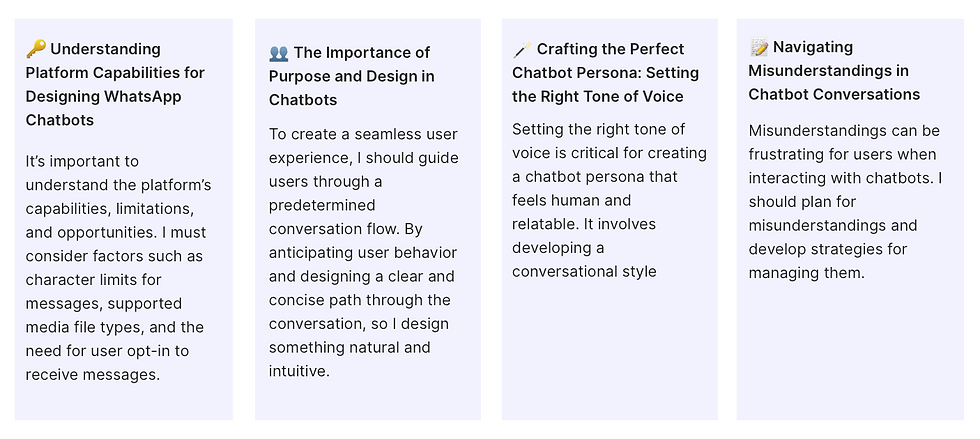
Main challenges faced in developing bot personality:
To create a bot:
That has artificial intelligence , but is human
That is modern and up to date, but can deal with anytype of person
That is pleasant and dynamic, but also professional and focused on goals
Execution
3. Developing the chatbot
These are the steps I took in developing the chatbot:
-
Personality Development: Building a Bot persona.
-
Artificial Intelligence: Depending on the use case and type of conversation, AI can be applied to execute the BOT persona.
-
Conversational Scripting: This step involves creating conversation flows for different aspects and implementing BOT personality behind each flow.
-
Context & Memory: This aspect enriches the functioning of the BOT giving it human-like functions.
🔎 Analysis of other bots:
I studied the visual language of other bots like Siri, google assistant, cortana, Alexa, Olivia etc and
understood that most bots focus on the AI/ technology part more than showcasing the human side.
However, I wanted to focus on the human element more, so I decided to work on the identity in way that showcases the expression of comfort and confidence.It was imperative that people could connect with it in an instant, in order to build trust.
3.1 Designing Bot personality
This led to:

In conversation, the primary desire of a user is to be understood. A user feels understood when the bot acknowledges every input they make. Acknowledgement, however, does not mean having a response for each input.
Designing the persona of the bot:

Bot positioning

3.2 How does an AI Chatbot work?
Keyword Matching: NoiseBud identifies specific keywords or phrases within the user input that correspond to predefined intents or actions, such as "track my order" or "cancel subscription."
Entity Recognition: NoiseBud recognizes entities within the user input, such as product names, order numbers, or user preferences, to extract relevant information for processing.
Intent Classification: NoiseBud classifies user intents based on the overall context of the conversation and the user's expressed needs or requests. It determines whether the user is seeking information, making a purchase, or requesting assistance with a specific issue.
Context Management: NoiseBud maintains context throughout the conversation, remembering previous interactions and user preferences to provide more personalized and relevant responses over time.

Pattern Matchers:
NoiseBud WhatsApp AI Chatbot operates using a combination of natural language processing (NLP) algorithms, pattern matching techniques, and predefined conversational flows to understand user queries and provide relevant responses.
3.3 Defining the chat architecture
A flow map
This map provides an overall view of how a conversation would flow to assist Monica, who is a user in this case. It outlines her potential goals, the probable scenarios she might encounter, and how Noisebud would redirect the conversation.

Chat Architecture and Scripting:
The aspects of conversation scripting are
-
Onboarding
-
Functional Scripting
-
Error Handling
-
Feedback
Onboarding:
Onboarding is the first interaction users see from noisebud—it could be a message that the bot sends to the logged-in user. It sets the first impression and tackles a set of tasks that can best be accomplished at the start of the conversation. Different approaches we can take while onboarding the users to the app:

A good bot should cover all these three aspects at some point during the conversation.Different approaches we can take while onboarding the users to the app.
Onboarding script for two different scenarios: Considering Monica's scenario.
In this use-case, the user was able to ask the bot what she wanted. However, with an open-ended approach, a user can ask any type of question. If the bot cannot answer these questions, it can create a weak first impression.


Feedback:
Feedback is a way for users to provide you with information about their experience with the bot. By collecting feedback from the user the BOT the makers of the bot can work on improving the experience of the bot.
When to obtain feedback?
-
User is Satisfied
-
User is not Satisfied or frustrated
We know the user is satisfied or frustrated by analysing the sentiments of the conversations. We can use certain keywords to understand the intent of the user to solicit feedback from him/her.

Memory:
When it comes to Memory, there are certain pieces of information about the user that the BOT must remember about to maintain context in conversations.
Information about the User the BOT should remember
-
Product Preferences:
-
Purchase History
-
Support Interactions.
-
Device Information
-
Feedback and Reviews
Functional Scripting:
A conversation with a BOT can be task-related or topic related.
Let’s consider the current use case:
Our user has been onboarded onto the app. She is now interested in getting advice on warranty and help as the earbuds she bought from the site turned out to be defective.


3.4 Final Development ideas
Even though I did not reach this stage , I used Dialogueflow to build and check my conversation flows with google assistant.To create AI conversations using WhatsApp, one would typically need to integrate with a conversational AI platform that supports WhatsApp as a messaging channel. Here are some platforms commonly used for creating AI conversations on WhatsApp.

Divergent Scenario:
The scenario we just discussed is often called an 'Ideal Scenario' or a 'Happy flow'. However, in the case of a responsive chatbot, users may not always provide the anticipated response.
A divergent scenario for NoiseBud might involve a situation where the user presents an unusual issue or request, diverging from standard customer support inquiries. Here's an example:

Learnings
8. Reflecting on the lessons
Working on this project has taught me that producing an excellent chatbot experience requires multiple revisions.. There are numerous options for how a user can communicate with a bot. As a result, it is critical to regularly monitor how your consumers engage with your bot.
There are currently no formal criteria for BOT design, however many platforms, like Google, Facebook, Microsoft, and Slack,have revealed their research and development processes. The study conducted by these companies had a significant impact on my work on this project.
Some of my core learnings were:
-
User-Centric Approach: Prioritizing user needs and feedback is paramount. Understanding user behavior, preferences, and painpoints helps tailor the chatbot's responses to provide valuable and personalized assistance.
-
Conversational Design: Crafting engaging and natural conversations requires a deep understanding of language nuances, conversational flows, and user intents. Iterative refinement based on user interactions is essential for enhancing the chatbot's effectiveness. I spent a lot of time learning about this domain, and combining it with business need , as I had little information on it.
-
Cross-Functional Collaboration: Collaborating with diverse teams, including product managers, developers, designers, and marketers, fosters synergy and alignment towards common objectives. Effective communication and collaboration drive innovation and accelerate project success.I kept on seeking constant help from the above people to drive my project forward.
Error Handling:

Error inputs are queries posed by a user for which the bot lacks an answer. NoiseBud may need to handle such errors in a variety of situations to ensure smooth and effective user interactions. Below are some scenarios where NoiseBud's error handling might be necessary:
Context:
It is difficult to maintain context when it comes to conversing with a bot. A lot of BOTs are designed as request/response systems. Although that is relevant for certain use cases and tasks, a BOT which acts as a personal assistant should understand the context. It is challenging to create a BOT which understands context.
As mentioned earlier that for BOT it is important to acknowledge all of the user intents.

2.2 User research to understand chatting patterns of users
I collaborated with the customer support team to understand chatting patterns and communication preferences of Noise's target audience
